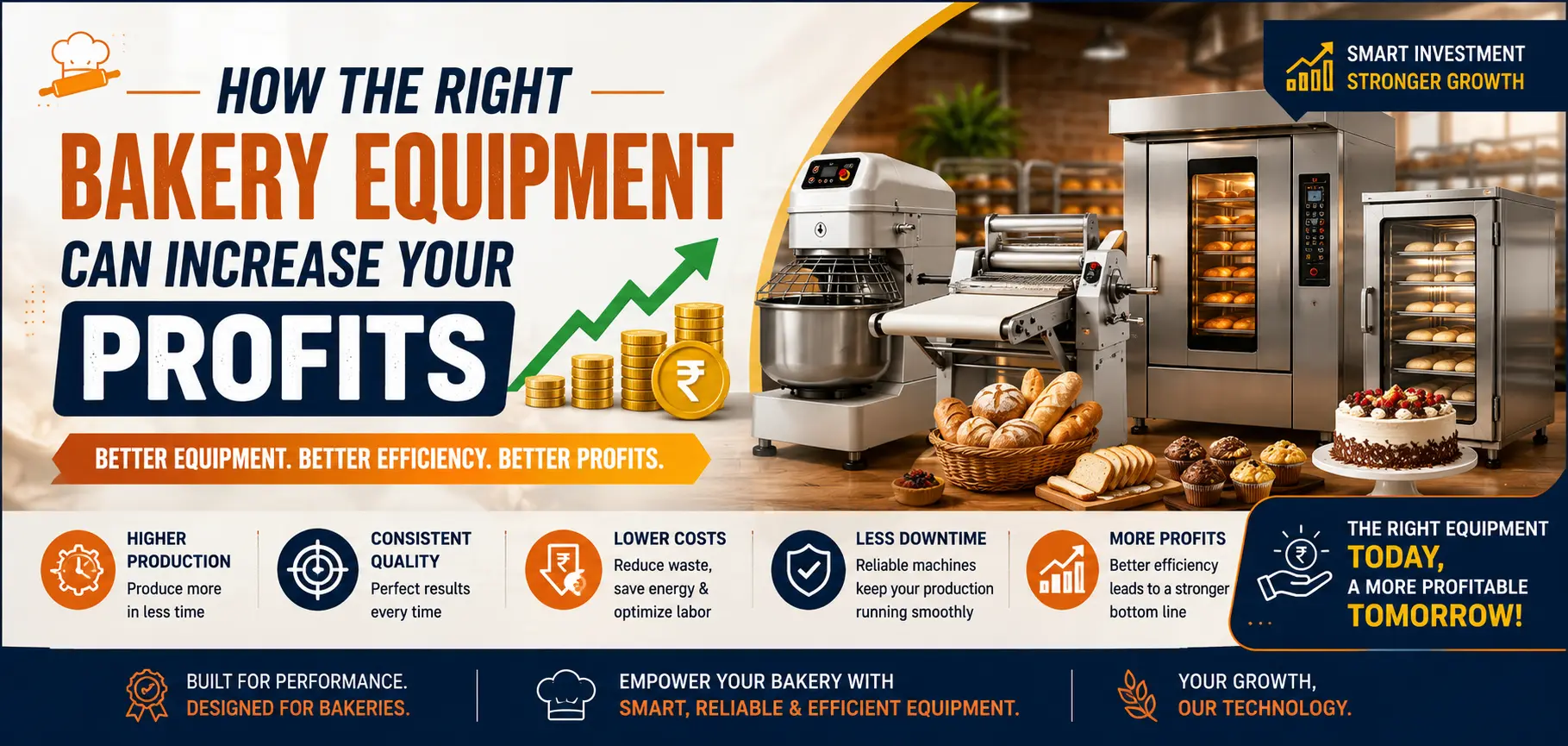
Introduction: Your Equipment Can Make or Break Your Profit
Running a successful bakery isn't just about making delicious products.
It's about making them consistently, efficiently, and profitably.
Every minute of production, every gram of ingredients, every unit of electricity, and every hour of employee time affects your bottom line. That's why investing in the right bakery equipment isn't simply an operational decision—it's a business strategy.
The right machinery can help you produce more in less time, reduce material waste, maintain consistent quality, and minimize costly downtime.
In other words:
Better equipment → Better efficiency → Lower costs → Higher profits.
Let's explore how the right bakery machinery can directly contribute to your bakery's profitability.
1. Increase Production Without Increasing Labor Proportionally
One of the biggest challenges for growing bakeries is increasing production while keeping labor costs under control.
Manual mixing, shaping, rolling, and processing can take considerable time and require more workers as order volumes increase.
Modern commercial bakery equipment can automate repetitive processes and increase production capacity.
For example:
- Spiral mixers can process large quantities of dough efficiently.
- Dough sheeters can create uniform dough thickness quickly.
- Dividers and rounders can standardize portion sizes.
- Rack ovens can handle multiple trays or racks efficiently.
- Packaging machines can accelerate the final production stage.
This allows your team to focus more on quality control, preparation, and other value-added activities.
2. Reduce Ingredient Waste
Waste is one of the silent profit killers in a bakery.
Small inconsistencies in dough weight, ingredient measurement, cutting, or portioning can become significant losses when repeated thousands of times.
Precision bakery machinery helps create greater consistency.
Automated equipment can help maintain:
- Consistent dough portions
- Uniform product sizes
- Accurate processing
- Repeatable mixing
- Consistent baking conditions
When every batch is closer to the intended specification, less material is lost.
A Simple Example
Suppose a bakery loses just 50 grams of dough per batch due to inconsistent processing.
If that happens across hundreds of batches every month, the cumulative waste can become surprisingly expensive.
Precision isn't just about appearance.
Precision protects profit.
3. Improve Product Consistency
Customers expect their favorite bread, cake, cookie, or pastry to taste the same every time.
Inconsistent products can lead to:
- Customer complaints
- Product returns
- Negative reviews
- Increased waste
- Loss of repeat business
The right bakery equipment helps standardize production conditions.
A quality mixer can deliver consistent mixing. A reliable oven can maintain stable baking conditions. A dough sheeter can produce uniform thickness.
The result?
More consistent products and happier customers.
And happy customers are more likely to come back.
4. Save Valuable Production Time
In a bakery, time is money.
A process that takes 30 minutes manually may take significantly less time with the appropriate machinery.
Consider common production tasks:
Mixing → Sheeting → Dividing → Proofing → Baking → Cooling → Packaging
Improving even one stage can increase overall production efficiency.
Faster processing means you can potentially:
- Produce more batches per shift
- Accept larger orders
- Respond faster to peak demand
- Reduce overtime
- Improve delivery schedules
The goal isn't simply to make machines run faster.
It's to make the entire production workflow smarter.
5. Reduce Dependence on Manual Repetitive Work
Manual labor remains important in bakery production, but repetitive tasks can consume valuable employee time.
Equipment can automate physically demanding or repetitive processes while allowing workers to concentrate on tasks that require human judgment.
For example, instead of manually rolling large quantities of dough, a bakery can use a dough sheeter.
Instead of manually mixing every large batch, an industrial mixer can perform the process with consistent mechanical action.
This can improve workplace productivity while helping employees work more efficiently.
6. Lower Energy Costs Through Efficient Equipment
Energy is another major operating expense for bakeries.
Ovens, mixers, refrigeration systems, proofers, and other machinery can consume significant amounts of electricity or fuel.
Choosing appropriately sized and efficiently designed equipment can help control energy consumption.
When evaluating machinery, consider:
- Motor efficiency
- Heating efficiency
- Insulation
- Operating capacity
- Production speed
- Standby consumption
- Maintenance requirements
The cheapest machine to purchase isn't always the cheapest machine to operate.
Think Beyond Purchase Price
A smart equipment investment considers the total cost of ownership:
Purchase Cost + Energy + Labor + Maintenance + Downtime + Waste
This gives you a much clearer picture of the machine's real financial impact.
7. Minimize Costly Machine Downtime
Imagine having hundreds of kilograms of dough ready for processing when your mixer suddenly stops.
Production stops.
Employees wait.
Orders are delayed.
Customers may be affected.
Unexpected equipment failure can be extremely expensive.
Choosing reliable bakery machinery and following a proper preventive maintenance program can help reduce the risk of unplanned downtime.
Regular inspections, lubrication, component replacement, and servicing can keep machines operating more reliably.
For advanced operations, IoT monitoring and predictive maintenance can provide additional visibility into equipment performance.
8. Scale Your Bakery More Easily
A bakery may start with a small production setup.
But what happens when orders double?
Without scalable equipment, increasing production may require significantly more labor, space, and operating time.
The right machinery creates a foundation for growth.
For example, upgrading from small-scale manual processing to suitable industrial bakery equipment can help a bakery handle higher production volumes without completely redesigning its business model.
This is particularly valuable for:
- Central kitchens
- Cloud bakeries
- Retail bakery chains
- Hotels
- Restaurants
- Food manufacturers
- Wholesale bakeries
- Large-scale production facilities
Equipment should support your growth—not become a bottleneck.
9. Improve Your Return on Investment
Every equipment purchase should answer one important question:
“How will this machine pay for itself?”
Suppose a machine costs ₹5,00,000.
Instead of looking only at the purchase price, calculate potential savings and additional revenue from:
- Reduced labor requirements
- Lower ingredient waste
- Increased production
- Reduced downtime
- Better product consistency
- Lower maintenance expenses
- Energy savings
If the equipment creates ₹50,000 of additional monthly value through a combination of higher output and lower costs, the investment could potentially recover its cost in a relatively short period.
The exact payback period will depend on your production volume, operating costs, equipment utilization, and product margins.
10. Choose Equipment Based on Your Actual Production Needs
One common mistake is buying equipment simply because it has a large capacity or many features.
More expensive doesn't automatically mean more profitable.
The best bakery machine is the one that matches your operation.
Before purchasing, consider:
Production Volume
How many kilograms, pieces, trays, or batches do you produce per day?
Product Type
Are you producing bread, pizza, cakes, pastries, cookies, biscuits, or multiple products?
Available Space
Can the machine fit comfortably into your production area while allowing safe operation and maintenance access?
Labor Availability
How much manual work do you want the machine to replace or reduce?
Future Growth
Will your production volume increase over the next few years?
Maintenance
Are spare parts and technical support readily available?
A machine should be selected based on business requirements—not just specifications.
Which Bakery Equipment Can Have the Biggest Profit Impact?
Different machines improve different parts of the production process.
| Equipment | Potential Business Benefit |
|---|---|
| Spiral Mixer | Higher dough capacity and consistent mixing |
| Planetary Mixer | Efficient mixing for creams, batters, and various bakery applications |
| Dough Sheeter | Faster processing and uniform dough thickness |
| Dough Divider | More consistent portioning and reduced dough waste |
| Rotary Rack Oven | High-capacity and consistent baking |
| Proofing Equipment | Better control over fermentation conditions |
| Packaging Equipment | Faster and more consistent packing |
| Industrial Refrigeration | Better product and ingredient storage management |
The key is to look at the entire production line rather than evaluating each machine in isolation.
The Profit Formula for a Modern Bakery
A profitable bakery can be thought of as a combination of several factors:
Higher Production
↓
Better Consistency
↓
Less Waste
↓
Lower Labor Cost per Unit
↓
Lower Downtime
↓
Better Customer Satisfaction
↓
Higher Profitability
The right bakery equipment can positively influence several of these factors simultaneously.
Smart Bakery Equipment Is an Investment, Not an Expense
It's easy to look at a machine's price tag and think:
“That's expensive.”
But the better question is:
“What will this machine save and earn over its working life?”
A well-selected machine can continue generating value through thousands of production cycles.
That's why bakery owners should evaluate machinery based on productivity, reliability, efficiency, maintenance, scalability, and return on investment.
The Future of Profitable Bakery Production
The bakery industry is becoming increasingly automated and data-driven.
Modern bakeries are adopting technologies such as:
- Automation
- IoT-connected equipment
- Digital control systems
- Predictive maintenance
- Smart sensors
- Energy monitoring
- Production analytics
- AI-assisted optimization
The objective isn't automation for the sake of automation.
It's about creating a production environment where every batch, every machine, and every minute contributes more effectively to profitability.
Final Thoughts
The right bakery equipment can do far more than mix dough or bake bread.
It can help a bakery produce more, waste less, work efficiently, maintain consistent quality, and scale with confidence.
The most profitable equipment investment isn't necessarily the machine with the lowest purchase price or the highest capacity.
It's the machine that delivers the best long-term value for your specific operation.
← Back to Blog