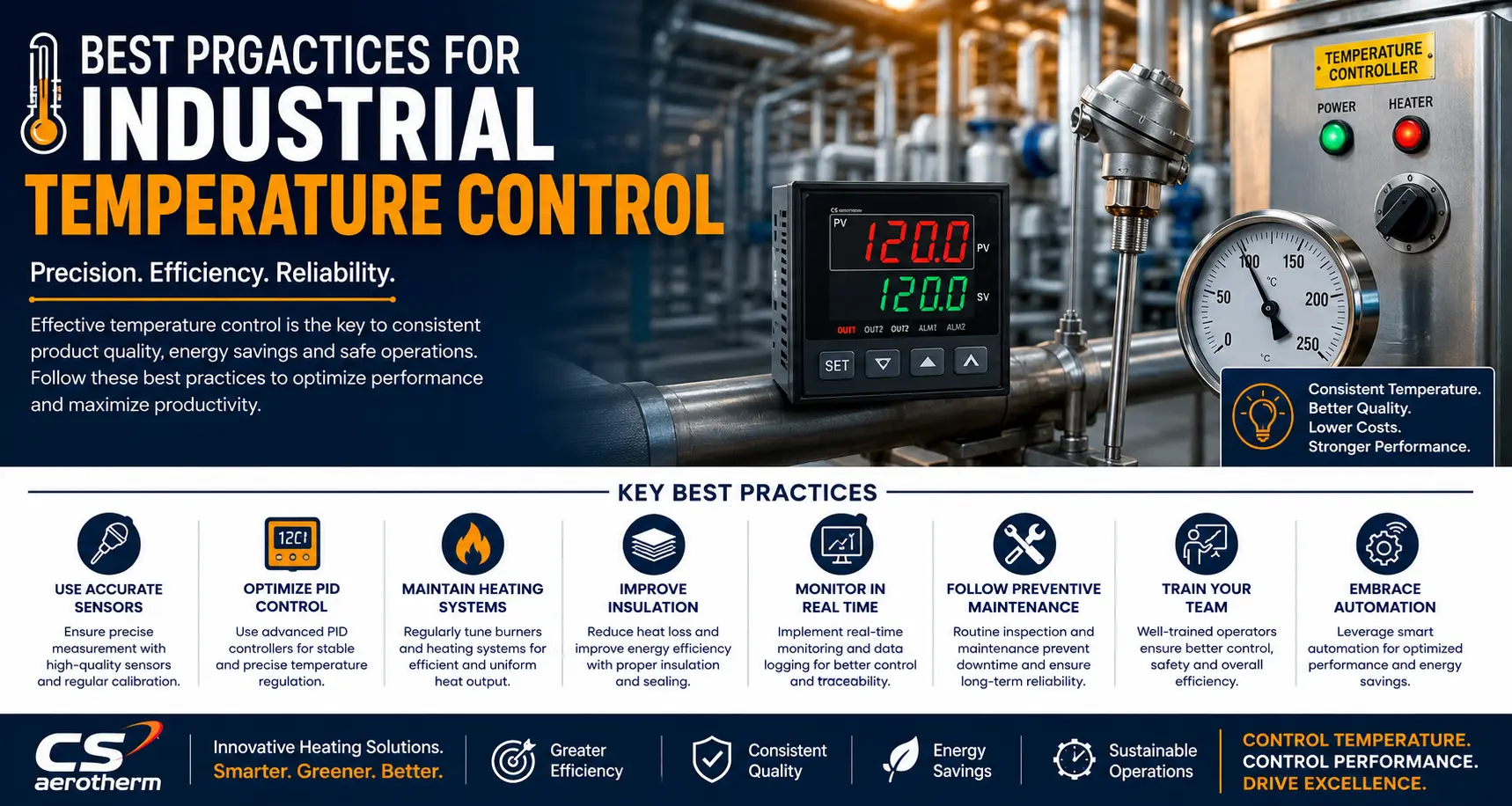
Best Practices for Industrial Temperature Control: Maximizing Efficiency, Product Quality, and Energy Savings
Why Accurate Temperature Control is the Backbone of Modern Industrial Heating Systems
In today's competitive manufacturing landscape, precise temperature control is essential for maintaining product quality, improving energy efficiency, reducing operating costs, and ensuring safe production processes. Industries such as bakeries, food processing, pharmaceuticals, chemicals, textiles, and manufacturing rely heavily on controlled heating systems to achieve consistent and repeatable results.
Whether you're operating industrial ovens, dryers, proofers, thermal fluid heaters, or process heating systems, implementing the right temperature control practices can significantly impact productivity and profitability.
In this guide, we'll explore the best practices for industrial temperature control and how businesses can optimize their heating operations for long-term success.
What is Industrial Temperature Control?
Industrial temperature control refers to the monitoring, regulation, and maintenance of specific temperatures within manufacturing and processing equipment. Advanced control systems ensure that heating processes remain within predefined temperature ranges to achieve desired product outcomes.
Effective temperature control helps:
- Maintain consistent product quality
- Reduce energy consumption
- Prevent equipment damage
- Improve process efficiency
- Enhance workplace safety
- Minimize production waste
Why Temperature Control Matters
Even minor temperature fluctuations can result in:
- Uneven product quality
- Increased fuel consumption
- Product rejection and waste
- Reduced equipment lifespan
- Higher operating costs
For industries such as bakery production and food processing, temperature consistency directly affects texture, appearance, moisture retention, and final product quality.
1. Invest in High-Quality Temperature Sensors
Temperature measurement is the foundation of any control system.
Using accurate and reliable sensors ensures precise process monitoring and helps prevent temperature deviations.
Recommended Sensors
- Thermocouples
- RTDs (Resistance Temperature Detectors)
- Infrared Temperature Sensors
- Digital Temperature Probes
Benefits
✔ Higher accuracy
✔ Faster response times
✔ Improved process stability
✔ Reduced operational errors
Regular sensor calibration is equally important to maintain measurement accuracy.
2. Use Advanced PID Temperature Controllers
PID (Proportional-Integral-Derivative) controllers are widely used in industrial heating systems because they automatically adjust heating output based on process conditions.
Advantages of PID Controllers
- Precise temperature regulation
- Reduced temperature overshoot
- Faster stabilization
- Improved energy efficiency
- Consistent production quality
Modern PID systems can be integrated with PLCs and automation platforms for enhanced process control.
3. Optimize Burner and Heating System Performance
For fuel-fired systems, burner efficiency directly influences temperature control performance.
Best Practices
- Regular burner tuning
- Proper air-to-fuel ratio adjustment
- Monitoring flame stability
- Routine combustion analysis
Optimized combustion ensures:
- Uniform heat generation
- Reduced fuel consumption
- Lower emissions
- Stable process temperatures
4. Improve Insulation and Heat Retention
Poor insulation is one of the leading causes of energy loss in industrial heating equipment.
Areas to Inspect
- Oven doors
- Heating chambers
- Ductwork
- Thermal oil piping
- Steam lines
Benefits of Proper Insulation
- Reduced heat loss
- Faster temperature recovery
- Lower fuel costs
- Improved system efficiency
Well-insulated equipment requires less energy to maintain target temperatures.
5. Implement Automated Temperature Monitoring
Automation eliminates manual temperature monitoring and improves process reliability.
Modern systems can provide:
- Real-time temperature tracking
- Data logging
- Remote monitoring
- Alarm notifications
- Predictive maintenance insights
Automation allows operators to identify temperature deviations before they impact production.
6. Establish Preventive Maintenance Programs
Temperature control systems require routine maintenance to perform effectively.
Maintenance Checklist
- Inspect sensors and probes
- Verify controller accuracy
- Check wiring connections
- Clean heating elements
- Test safety devices
- Inspect insulation condition
Preventive maintenance minimizes unexpected downtime and ensures continuous operation.
7. Utilize Zoned Heating Control
Large industrial ovens and heating chambers often experience uneven heat distribution.
Zoned heating systems divide equipment into multiple temperature-controlled sections.
Advantages
- Better temperature uniformity
- Reduced hot spots
- Enhanced product consistency
- Improved energy utilization
This approach is especially valuable in bakery tunnel ovens and industrial drying systems.
8. Monitor and Analyze Energy Consumption
Temperature control and energy efficiency go hand in hand.
Using energy monitoring systems helps identify:
- Excessive fuel usage
- Heat loss areas
- Inefficient operating patterns
- Equipment performance issues
Regular energy audits can uncover opportunities for significant cost savings.
9. Train Operators on Temperature Management
Even the most advanced systems depend on knowledgeable operators.
Training programs should cover:
- Temperature control principles
- Equipment operation
- Alarm management
- Troubleshooting procedures
- Safety practices
Well-trained staff contribute to better process consistency and reduced operational errors.
10. Integrate Smart Industry 4.0 Technologies
Modern industrial facilities are increasingly adopting Industry 4.0 solutions.
Smart temperature control systems offer:
- IoT-enabled monitoring
- Cloud-based analytics
- Predictive maintenance
- Automated reporting
- Real-time performance dashboards
These technologies provide deeper insights into process performance and help optimize energy usage.
Common Temperature Control Challenges
Temperature Fluctuations
Often caused by:
- Poor sensor placement
- Inadequate controller tuning
- Burner inefficiencies
Uneven Heat Distribution
Can result from:
- Airflow problems
- Worn heating components
- Insufficient insulation
Excessive Energy Consumption
Typically linked to:
- Heat losses
- Outdated control systems
- Poor maintenance practices
Identifying the root cause is critical for achieving stable and efficient operations.
The Role of Temperature Control in Sustainable Manufacturing
Sustainability has become a major focus across industries.
Accurate temperature control contributes to sustainability by:
- Reducing fuel consumption
- Lowering carbon emissions
- Minimizing production waste
- Extending equipment lifespan
- Supporting energy conservation initiatives
Businesses that optimize temperature control not only reduce costs but also strengthen their environmental performance.
Why Choose CS Aerotherm for Industrial Heating Solutions?
At CS aerotherm, we specialize in innovative industrial heating technologies designed to deliver precise temperature control, exceptional energy efficiency, and reliable performance.
Our solutions support industries including:
- Bakery Manufacturing
- Food Processing
- Chemical Processing
- Pharmaceuticals
- Industrial Production Facilities
With advanced engineering and a commitment to sustainability, CS aerotherm helps businesses achieve greater productivity while reducing operational costs.\
Conclusion
Industrial temperature control is far more than simply maintaining a set temperature. It is a critical factor that influences product quality, operational efficiency, energy consumption, and overall profitability.
By investing in advanced control technologies, preventive maintenance, automation, and energy-efficient heating systems, manufacturers can achieve superior process performance and long-term business success.
As industries continue to embrace automation and sustainability, effective temperature control will remain one of the most valuable tools for improving productivity and reducing costs.
← Back to Blog