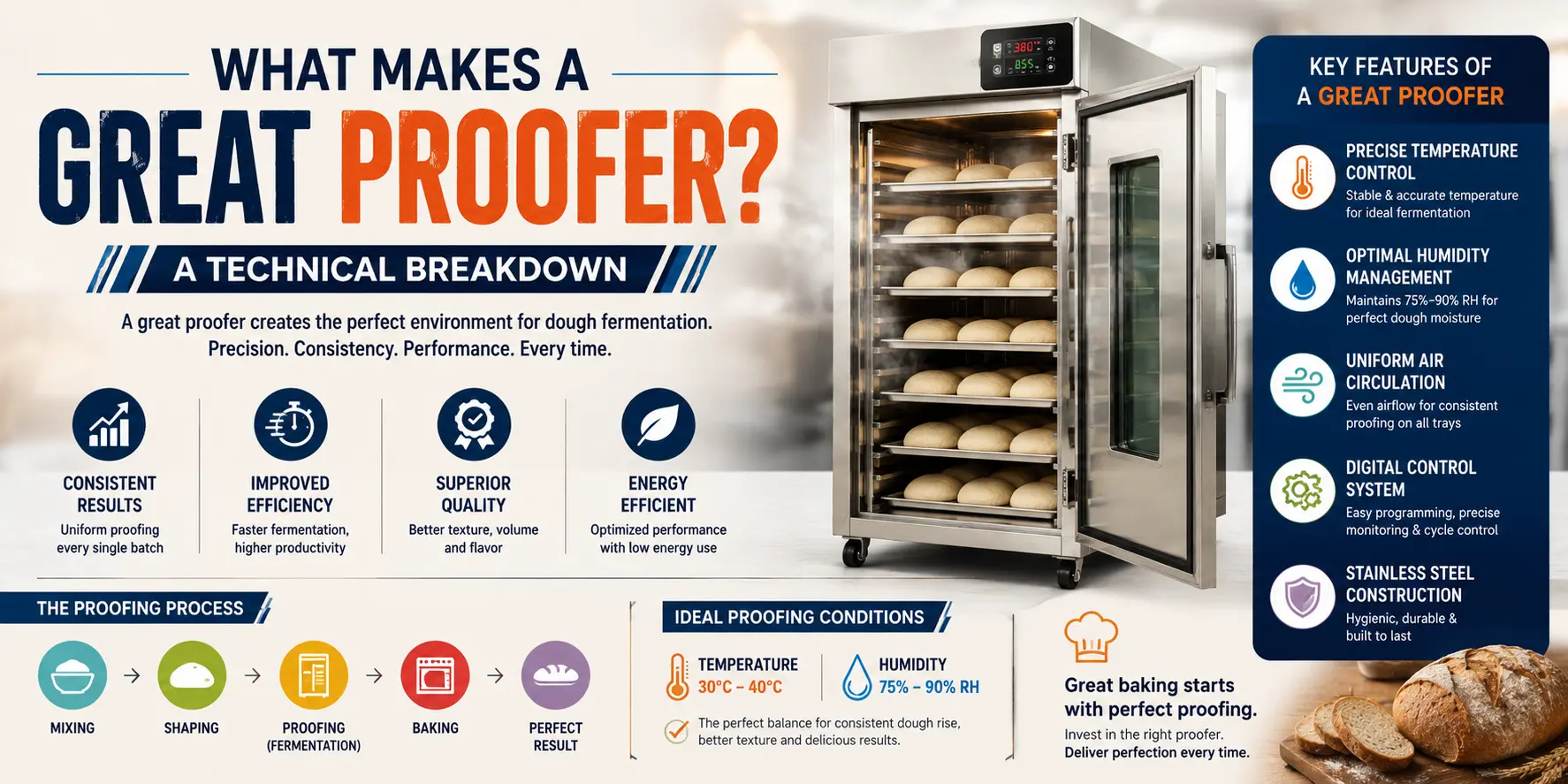
What Makes a Great Proofer? A Technical Breakdown
The Science Behind Perfect Dough Fermentation
In every successful bakery, consistency is the secret ingredient. From artisan bread and soft buns to croissants and pizza bases, achieving the perfect texture begins long before baking—it starts in the proofer.
A commercial proofer creates the ideal environment for dough fermentation by maintaining precise temperature and humidity levels. The quality of proofing directly impacts dough volume, crust, crumb structure, flavor, and overall product consistency.
But what truly makes a great proofer? In this technical guide, we'll break down the essential features, technologies, and performance factors that define a high-quality commercial proofer and why investing in the right equipment is crucial for every modern bakery.
What Is a Bakery Proofer?
A bakery proofer is specialized equipment designed to provide controlled temperature and humidity, allowing yeast to ferment dough efficiently before baking.
Unlike room-temperature proofing, commercial proofers ensure:
- Uniform dough rise
- Consistent fermentation
- Better product quality
- Reduced production time
- Higher batch consistency
Whether you're producing bread, rolls, pastries, or pizza dough, a proofer ensures every batch performs exactly as expected.
Why Proper Proofing Matters
Proofing is one of the most critical stages in bread production. Poor proofing can result in:
- Dense bread
- Uneven texture
- Cracked crust
- Reduced volume
- Inconsistent baking
- Lower customer satisfaction
Proper proofing ensures dough develops the strength, elasticity, and flavor needed for premium baked products.
Technical Features That Define a Great Proofer
1. Precise Temperature Control
Temperature is the foundation of effective fermentation.
High-performance proofers maintain stable temperatures, typically between 30°C and 40°C, preventing fluctuations that can negatively affect yeast activity.
Benefits include:
- Faster fermentation
- Uniform dough expansion
- Consistent product quality
- Reduced proofing errors
Advanced digital controllers ensure accurate temperature regulation throughout the proofing cycle.
2. Accurate Humidity Management
Humidity plays an equally important role.
An ideal bakery proofer maintains 75%–90% relative humidity, preventing dough from drying while allowing proper yeast development.
Proper humidity helps:
- Prevent crust formation
- Maintain dough elasticity
- Improve oven spring
- Produce softer bread
Modern steam-based humidification systems provide even moisture distribution across all trays.
3. Uniform Air Circulation
Even airflow ensures every tray receives the same temperature and humidity.
Poor air circulation creates:
- Uneven proofing
- Over-proofed areas
- Under-proofed dough
- Product inconsistency
Premium proofers use engineered airflow systems that distribute conditioned air uniformly throughout the chamber.
4. Energy-Efficient Heating System
Energy efficiency is a major consideration for commercial bakeries operating multiple production shifts.
Advanced proofers incorporate:
- High-efficiency heating elements
- Insulated panels
- Intelligent temperature recovery
- Low heat loss
These features reduce energy consumption while maintaining stable proofing conditions.
5. Digital Control Panel
Modern proofers feature intuitive touchscreen or digital control systems that allow operators to:
- Set temperature
- Adjust humidity
- Program proofing cycles
- Monitor chamber conditions
- Save production recipes
Automation minimizes operator error and improves repeatability.
6. Stainless Steel Construction
Food-grade stainless steel ensures:
- Easy cleaning
- Corrosion resistance
- Long equipment life
- Improved hygiene
- Compliance with food safety standards
A durable construction also withstands demanding commercial bakery environments.
7. High-Quality Insulation
Proper insulation helps maintain stable internal conditions while minimizing energy loss.
Advantages include:
- Consistent proofing
- Faster recovery after door opening
- Lower operating costs
- Reduced environmental impact
8. Flexible Tray Capacity
A great proofer should match production requirements.
Available configurations include:
- Single-door proofers
- Double-door proofers
- Swing tray proofers
- Rack proofers
- Integrated proofer systems
Scalable capacities allow bakeries to grow without compromising efficiency.
Advanced Technologies in Modern Proofers
Today's commercial proofers incorporate smart technologies that enhance productivity and precision.
Programmable Proofing Cycles
Operators can store multiple recipes for different bakery products, ensuring repeatable results.
Automated Humidity Generation
Steam generators maintain optimal humidity without manual intervention.
Smart Sensors
Integrated sensors continuously monitor chamber conditions and automatically adjust settings.
Energy Optimization
Modern control systems reduce power consumption during idle periods while maintaining readiness for production.
Common Proofing Problems and Their Solutions
Problem | Possible Cause | Recommended Solution |
|---|---|---|
| Dough dries out | Low humidity | Increase humidity level |
| Uneven rising | Poor airflow | Improve air circulation |
| Sticky dough | Excess humidity | Optimize moisture settings |
| Slow fermentation | Low temperature | Increase chamber temperature |
| Collapsed dough | Over-proofing | Reduce proofing time |
How to Choose the Right Commercial Proofer
Before investing in a proofer, consider the following:
Production Capacity
Select a model that aligns with your daily output requirements.
Temperature Accuracy
Choose equipment with reliable digital temperature control.
Humidity Precision
Look for advanced humidification systems that provide consistent moisture levels.
Ease of Operation
User-friendly controls simplify daily bakery operations.
Maintenance Requirements
Opt for equipment designed for easy cleaning and servicing.
Energy Efficiency
Lower energy consumption reduces long-term operating costs.
Build Quality
Food-grade stainless steel construction ensures durability and hygiene.
Benefits of Investing in a High-Quality Proofer
A premium proofer delivers measurable operational advantages:
- Consistent dough fermentation
- Superior bread volume
- Improved crumb structure
- Better crust development
- Reduced production waste
- Higher productivity
- Faster processing times
- Lower labor costs
- Energy savings
- Greater customer satisfaction
Why Bakers Choose CS aerotherm Proofers
At CS aerotherm, we design and manufacture advanced commercial proofers that combine precision engineering, energy efficiency, and robust construction. Our proofing solutions are tailored to meet the demands of artisan bakeries, industrial baking facilities, hotels, restaurants, and food production units.
With advanced temperature and humidity control, uniform airflow, hygienic stainless steel construction, and reliable automation, CS aerotherm proofers help bakers achieve consistent fermentation and exceptional baking results every day.
← Back to Blog