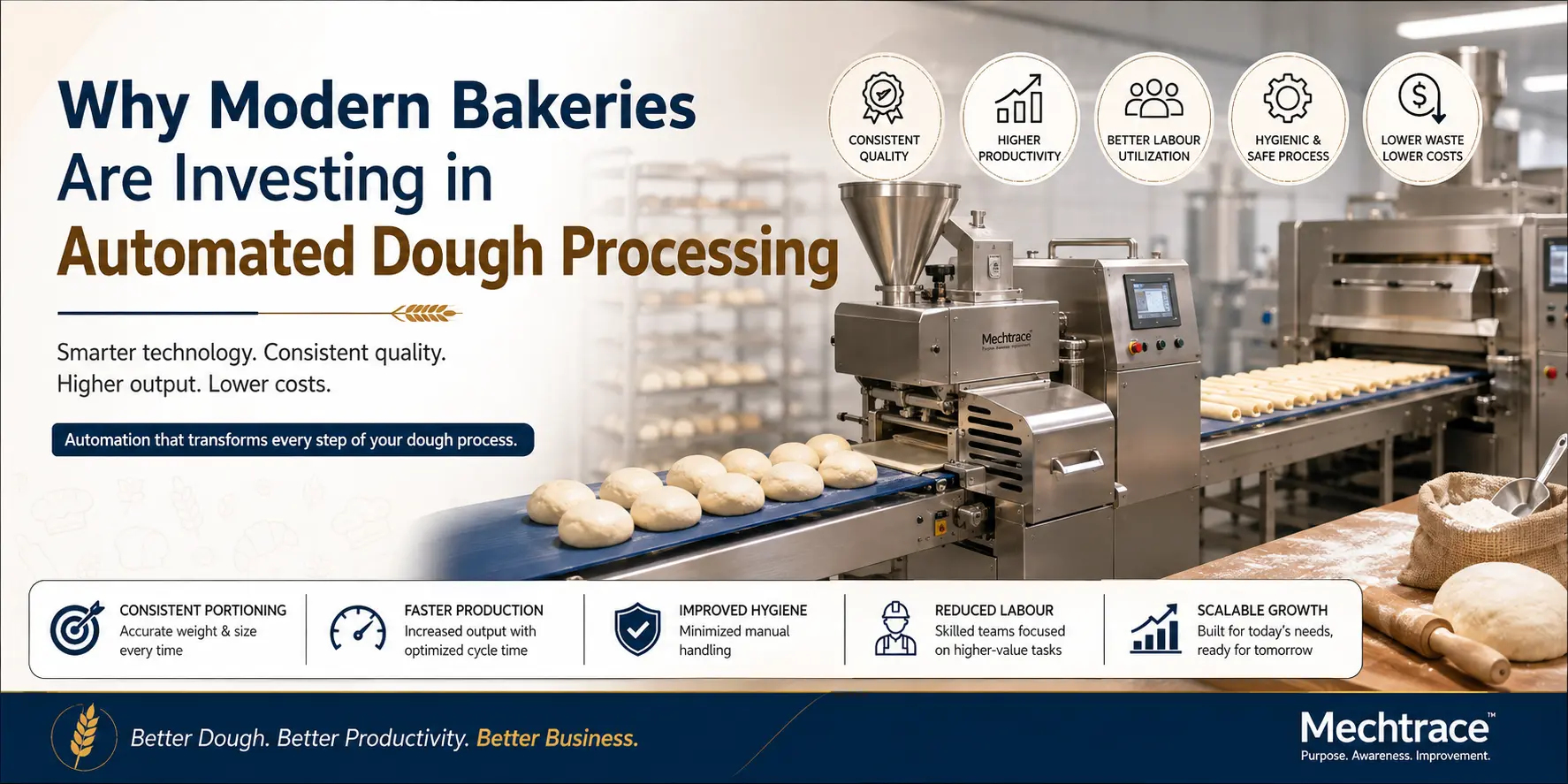
Why Modern Bakeries Are Investing in Automated Dough Processing
The bakery industry is changing rapidly. Rising demand, tighter production schedules, consistent product expectations, and the need to control operating costs are pushing bakeries to rethink traditional production methods.
One of the biggest transformations is happening before the dough even reaches the oven.
From mixing and dividing to sheeting, rounding, moulding, and proofing, modern bakeries are increasingly investing in automated dough processing equipment to create faster, more consistent, and scalable production systems.
But why is automation becoming such an important investment?
The answer is simple: modern bakeries are no longer competing only on taste—they are competing on consistency, efficiency, capacity, and speed.
The Shift From Manual Dough Handling to Automation
Traditional dough processing depends heavily on manual labour. While skilled bakery workers remain valuable, manually handling large quantities of dough can create variations in weight, shape, thickness, and processing time.
As production volumes increase, these small variations can become significant.
Automated dough processing systems help standardize repetitive operations and create a more controlled production flow.
Instead of relying entirely on manual processes, bakeries can integrate equipment for:
- Dough mixing
- Dough dividing
- Dough rounding
- Dough sheeting
- Dough moulding
- Dough pressing
- Dough proofing
- Dough handling and conveying
The result is a more organized production line with greater control over every stage.
1. Consistency Is the New Competitive Advantage
Customers expect the same product every time.
Whether it is bread, buns, pizza bases, rolls, rusk, or other bakery products, consistent weight, size, shape, texture, and appearance are critical.
Manual processing can introduce variations due to operator technique, fatigue, speed, or changing working conditions.
Automation helps minimize these variations.
For example, an automated dough divider can portion dough more consistently, while a dough sheeter can maintain more uniform thickness.
This means every batch has a better chance of meeting the bakery's predefined production standards.
Consistency builds customer trust.
2. Higher Production Capacity Without Proportionally Increasing Labour
As bakery orders grow, businesses need additional production capacity.
One option is to increase the workforce. However, continuously adding manpower can increase operating costs and make production management more complicated.
Automated dough processing offers another approach.
Machines can perform repetitive operations continuously and at controlled speeds, allowing bakeries to increase output without depending entirely on additional manual labour.
This is especially valuable for:
- Industrial bakeries
- Commercial bakeries
- Central kitchens
- Large restaurants
- QSR chains
- Frozen bakery producers
- High-volume bread manufacturers
Automation allows businesses to scale production more systematically.
3. Reduced Dough Processing Time
Time is one of the most valuable resources in bakery production.
Every unnecessary delay can affect production schedules, labour utilization, and delivery commitments.
Automated dough processing equipment is designed to streamline repetitive tasks and reduce unnecessary handling.
A well-designed production flow can move dough efficiently from one stage to the next:
Mix → Divide → Round → Sheet/Mould → Proof → Bake
Reducing manual intervention between these stages can improve overall production flow and help bakeries achieve higher throughput.
4. Better Labour Utilization
Automation does not necessarily mean replacing people.
In many modern bakeries, the objective is to use people where their skills create the most value while allowing machines to handle repetitive and physically demanding operations.
Instead of spending hours manually portioning or shaping dough, employees can focus on:
- Production supervision
- Quality control
- Machine operation
- Recipe management
- Maintenance coordination
- Packaging
- Process improvement
This creates a more efficient relationship between people and technology.
5. Improved Hygiene and Process Control
Food hygiene is a major consideration for every professional bakery.
Excessive manual handling can increase opportunities for contamination if processes are not properly controlled.
Automated dough processing can reduce unnecessary human contact with the product and create a more structured production environment.
Modern bakery equipment can also be designed with features that support:
- Easy cleaning
- Stainless-steel construction
- Controlled dough handling
- Organized production flow
- Improved workplace hygiene
Better process control contributes to a more reliable food-production environment.
6. Less Product Waste
Waste directly affects bakery profitability.
Inconsistent dough weights, incorrect portioning, excessive trimming, and processing errors can increase material losses.
Automated equipment can help improve portion consistency and process repeatability.
Even a small reduction in dough wastage can become financially significant when a bakery processes hundreds or thousands of kilograms of dough every day.
Small improvements multiplied by high production volumes can create major savings.
7. Automation Supports Business Growth
A bakery may begin with a relatively small production volume.
But as the brand grows, demand can increase dramatically.
What works for 100 kg of dough per day may not work efficiently for 1,000 kg or 5,000 kg.
This is why automation should be viewed not only as a production investment but also as a growth strategy.
The right dough processing equipment can help a bakery prepare for:
More orders → Higher production → Better consistency → Greater market reach
Automation provides the infrastructure required to handle increased demand without completely redesigning the production process every time capacity needs to grow.
8. Data and Smart Manufacturing Are Changing Bakery Production
Automation is increasingly moving beyond mechanical operation.
Modern manufacturing is becoming more data-driven, and bakery production is following the same direction.
Businesses are becoming more interested in understanding:
- Production output
- Machine utilization
- Downtime
- Cycle time
- Production losses
- Quality performance
- Maintenance requirements
This creates an important connection between automated bakery equipment and smart manufacturing systems.
When production equipment is combined with monitoring and management technologies, bakery owners and production managers can make decisions based on actual performance rather than assumptions.
9. Automation Helps Build a Repeatable Production System
A successful bakery should not depend entirely on one highly experienced operator knowing exactly how everything should be done.
A scalable bakery needs processes that can be repeated.
Automation helps convert individual skills and manual procedures into standardized production processes.
This can be particularly valuable when bakeries:
- Open multiple production facilities
- Expand into new markets
- Increase product ranges
- Operate multiple shifts
- Supply large retail chains
- Produce products for multiple locations
Standardization makes expansion easier to manage.
Choosing the Right Dough Processing Equipment
Investing in automation does not mean buying every available machine.
The best solution depends on the bakery's:
- Production capacity
- Product range
- Dough characteristics
- Available floor space
- Labour availability
- Desired automation level
- Budget
- Future expansion plans
A bakery producing artisan products may need a different solution from a high-volume bread manufacturing plant.
Therefore, equipment selection should begin with process analysis, not simply machine selection.
Ask:
What is slowing production down?
Where is inconsistency occurring?
Where is labour being used for repetitive tasks?
Where are material losses happening?
Which process needs better control?
The answers can guide the right automation strategy.
The Future of Bakery Production Is Smarter, Faster and More Connected
Automated dough processing is becoming more than a way to speed up production.
It is becoming a foundation for modern bakery manufacturing.
The future bakery will increasingly combine:
Automation + Precision + Data + Process Control + Skilled People
This combination can help businesses improve productivity while maintaining the quality that customers expect.
The goal is not simply to produce more dough.
The goal is to produce better, more consistent products with greater control and less waste.
Final Thoughts
Modern bakeries are investing in automated dough processing because the demands of the industry are changing.
Customers want consistency.
Businesses want efficiency.
Employees need better working environments.
Production managers need greater control.
And growing bakeries need scalable systems.
From dough dividers and rounders to dough sheeters, moulders, mixers, proofers, and complete automated production lines, the right technology can transform the way a bakery operates.
Ultimately, bakery automation is not just about replacing manual work.
It is about creating a smarter production system built for consistency, efficiency, and growth.
← Back to Blog