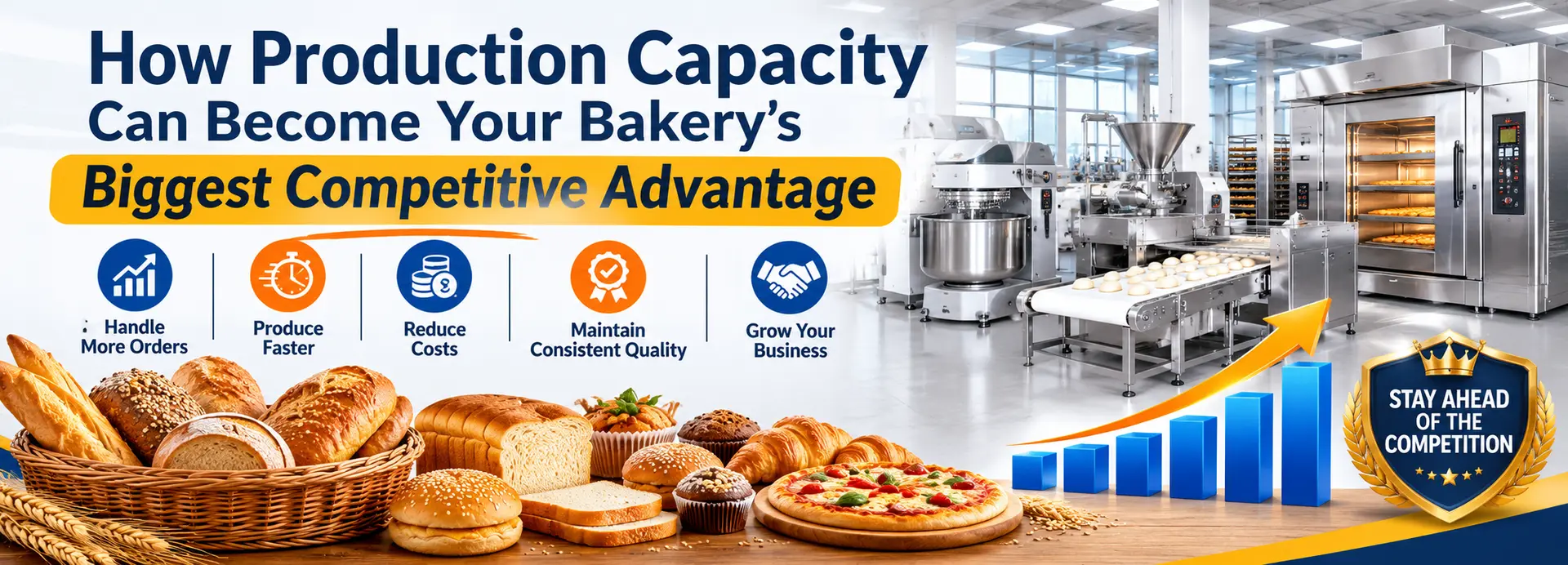
Introduction: In the Bakery Business, Speed and Consistency Matter
Imagine two bakeries receiving the same large order for 5,000 bread loaves. One struggles to complete the order on time, while the other delivers fresh, perfectly baked products ahead of schedule.
What makes the difference?
It is not always the quality of ingredients or the experience of the baker. Often, the real difference lies in production capacity.
In today's competitive bakery industry, customers expect fresh products, consistent quality, competitive pricing, and timely delivery. Bakeries that can meet these expectations while handling increasing order volumes have a significant advantage over their competitors.
Production capacity is no longer just about making more products. It is about producing smarter, faster, and more efficiently.
Let's explore how the right production capacity can become your bakery's biggest competitive advantage.
1. Fulfil More Orders Without Compromising Quality
As your bakery business grows, customer demand grows with it. Retail outlets, supermarkets, hotels, restaurants, and distributors may start placing larger and more frequent orders.
Without sufficient production capacity, fulfilling these orders becomes challenging.
A well-planned bakery production setup helps you:
- Handle bulk orders efficiently.
- Maintain consistent product quality.
- Reduce production delays.
- Meet customer delivery deadlines.
- Expand your customer base confidently.
Investing in suitable industrial bakery equipment allows your business to increase output without putting unnecessary pressure on your workforce.
Remember: More production should never mean less quality.
2. Reduce Production Time with Advanced Bakery Equipment
Time is one of the most valuable resources in a commercial bakery.
Traditional manual processes can slow down production, especially when demand increases. Advanced bakery machines help automate repetitive operations and improve overall production speed.
Some essential machines include:
- Spiral Mixer: Ensures uniform dough mixing with efficient handling of large batches.
- Rotary Rack Oven: Supports high-volume baking with consistent heat distribution.
- Dough Divider: Divides dough into uniform portions, reducing manual effort.
- Conical Rounder: Produces evenly rounded dough balls for consistent results.
- Bread Moulder: Shapes dough efficiently for large-scale bread production.
- Automatic Slicer: Delivers uniform bread slices with improved speed and consistency.
- Industrial Proofer: Provides controlled proofing conditions for reliable dough development.
When these machines work together in an efficient production line, your bakery can produce more in less time.
3. Lower Your Production Cost Per Unit
One of the biggest advantages of increasing production capacity is the opportunity to reduce the cost of producing each item.
Consider this example:
If your bakery spends ₹10,000 to produce 1,000 loaves, the production cost is ₹10 per loaf.
If improved equipment and workflow allow you to produce 2,000 loaves with a total production cost of ₹16,000, your cost becomes ₹8 per loaf.
This is an illustrative example, but it demonstrates how better production efficiency can improve profitability.
Higher production capacity can help reduce:
- Labour cost per unit.
- Equipment downtime.
- Material wastage.
- Repeated manual operations.
- Production bottlenecks.
The goal is not simply to produce more. It is to make every production cycle more profitable.
4. Maintain Consistent Product Quality at Every Scale
Customers return to bakeries because they trust the taste, texture, appearance, and freshness of their products.
However, maintaining consistency becomes difficult when production volumes increase.
Manual processes may result in variations in dough weight, product shape, baking temperature, and baking time.
Modern bakery equipment helps maintain standardised production through:
- Accurate dough portioning.
- Controlled mixing operations.
- Uniform proofing conditions.
- Consistent baking temperatures.
- Standardised product shaping.
Whether you produce 100 or 10,000 bakery products, a properly designed production system helps maintain the quality your customers expect.
5. Respond Faster to Market Demand
The bakery market changes constantly. Seasonal celebrations, festivals, special occasions, and changing consumer preferences can create sudden increases in demand.
For example:
- Bakeries experience higher demand during Diwali and Christmas.
- Bread and bun manufacturers receive larger orders from hotels and restaurants.
- Pizza base manufacturers need to fulfil bulk requirements from food outlets.
- Khari and rusk manufacturers may experience increased retail demand.
A bakery with sufficient production capacity can respond to these opportunities without delaying existing orders.
The ability to scale production quickly gives your business greater flexibility and helps you capture more market opportunities.
6. Automation Helps Your Bakery Grow Without Increasing Manual Work
Hiring more workers is not always the most effective solution to increasing production.
A better approach is to identify repetitive processes that can be automated.
Depending on your production requirements, automated and semi-automatic bakery machines can help reduce manual handling and improve workflow efficiency.
For example:
- Automated dough handling reduces repetitive manual operations.
- Mechanical dividing improves portion accuracy.
- Continuous production lines support higher output.
- Digital oven controls help standardise baking operations.
- IoT-enabled bakery equipment can provide useful operational information and improve process monitoring.
Automation allows your workforce to focus on quality control, supervision, and other important production activities.
7. Build a Bakery Production Line That Supports Future Growth
Buying individual machines without considering the complete production process can create unnecessary bottlenecks.
A successful bakery production line should be designed around the complete manufacturing workflow.
A typical bread production process includes:
- Ingredient preparation and weighing.
- Dough mixing using a spiral mixer.
- Dough dividing and rounding.
- Intermediate resting and proofing.
- Dough moulding.
- Final proofing.
- Baking in a rotary rack oven or tunnel oven.
- Cooling and slicing.
- Packaging and dispatch.
Each stage should have sufficient capacity to support the next stage.
For example, purchasing a high-capacity oven will not improve overall output if your dough preparation or proofing section cannot supply enough products.
A balanced production line is more valuable than simply owning high-capacity machines.
8. Use Smart Technology to Improve Production Efficiency
Technology is transforming the modern bakery industry.
IoT-enabled bakery equipment and digital control systems can help operators monitor important production parameters and make better operational decisions.
Depending on the system's features, smart bakery equipment can support:
- Temperature monitoring.
- Baking cycle management.
- Equipment performance tracking.
- Process consistency.
- Production data analysis.
- Improved maintenance planning.
With better visibility into production operations, bakery owners can identify inefficiencies and take corrective action before small problems become major production challenges.
9. Choose the Right Bakery Equipment for Your Production Goals
Not every bakery needs the same production capacity.
A small neighbourhood bakery may require a compact deck oven and a suitable mixer, while a large commercial bakery may need rotary rack ovens, industrial mixers, automatic dividing systems, proofers, and complete production lines.
Before investing in new equipment, consider:
- Your current daily production volume.
- Your expected future demand.
- Available floor space.
- Product varieties.
- Labour availability.
- Energy consumption.
- Equipment maintenance requirements.
- Budget and return on investment.
The right equipment should support your current business while providing room for future expansion.
10. Turn Production Capacity into a Long-Term Competitive Advantage
Your competitors may offer similar products and prices. But your ability to fulfil larger orders, maintain consistent quality, reduce delivery times, and manage production costs can set your bakery apart.
A bakery with an efficient production system can:
- Accept larger commercial orders.
- Supply multiple retail outlets.
- Expand into new markets.
- Introduce new product varieties.
- Improve customer satisfaction.
- Increase business profitability.
Production capacity is not just a manufacturing metric. It is a strategic investment in your bakery's future.
Conclusion: Produce More, Grow Smarter, Compete Stronger
In the modern bakery industry, success depends on more than great recipes. It requires the right combination of skilled people, efficient processes, advanced technology, and reliable bakery equipment.
Increasing production capacity gives your bakery the confidence to accept bigger orders, respond to market demand, maintain product consistency, and grow without unnecessary operational pressure.
At CS Aerotherm, we believe that the right bakery equipment can transform the way bakeries produce, operate, and grow. From spiral mixers and dough handling machines to rotary rack ovens and complete bakery production lines, choosing the right machinery is an important step towards building a more productive bakery business.
← Back to Blog